News
What we've built, what worked, and what didn't, newest first. Dates are Mountain Time (America/Denver).
Correction: how we described logins on Under Fire
Earlier Under Fire updates, here and on our social accounts, said "Logins or admin access by outsiders: 0" and "nothing has got through". Those numbers came from automated log rules, and the plain wording claimed more than we had checked. On Nov 8 we reviewed every accepted SSH login on both servers from the start of our logs (Oct 24) through Nov 8, and every one matched our own access. So we can now say: no intrusions found in that review. It does not show which tool stopped any given attempt; whether FNAI Sentinel specifically prevented anything is still unverified. The Under Fire page and the Security Story now carry a dated correction note.
Twins Raised Apart: week 1 (null result)
Week 1 (Nov 7): both twins answered all 10 anchor questions, each in a fresh chat. Their answers matched at 0.361 on average (0 = nothing shared, 1 = identical), close to the week 0 baseline of 0.376. Each twin's change from its own week 0 answers (box 0.63, web 0.65) is about the same as the same-day re-test noise we measured on Oct 31 (0.61, 0.56), so most of it looks like ordinary run-to-run variation. Null result: no change crossed our thresholds. Early signal: two weekly points so far; the drift measure needs at least eight. Methods note: since Nov 1 the box twin has a private workspace, so its results from week 1 on reflect a changed condition.
Teaching Chain: rounds 2 and 3 (mixed results)
Rounds 2 (Nov 1) and 3 (Nov 8): each round the mentor passed one method lesson to two students. Keyword retention from the original lesson to the students averaged 0.20 in round 2 (one student kept none) and 0.40 in round 3; text similarity to the lesson stayed low (0.10 and 0.13). Mixed result: in round 3 the mentor's note to the students kept the lesson's words, but the mentor's own explanation turned "label early signals as early" into "identify the most promising areas", the same drift we saw in round 0. Caveat: our automated meaning judge, a small model, scored both students 1.0 and the mentor note 0.5. On manual review it over-scored the students, who framed the lesson as avoiding premature conclusions rather than as how to report findings, and under-scored the note. Manual review overrides the judge. Early signal: four rounds with a small model; this is not a finding.
Impossible Questions: week 1 close-out (misses and failures included)
Question 1 was "What happened before the Big Bang, if 'before' means anything?" Five of seven daily sessions ran; days 5 and 6 (Nov 4-5) were missed while our scheduler was down. Twin A's final reply was a short sign-off, not an answer, after two long days that our overclaim check flagged. Twin B repeated one paragraph that, in its own words, did not directly answer the question. The box twin restated what is known and unknown and called "before" speculation: high on honesty about uncertainty all week, low on originality, and two near-identical days. The web twin's final answer timed out, so it has none. No twin produced a new angle by our heuristic. Early signal: heuristic scores only, not judgments of truth. Week 2 ("Why is there something rather than nothing?") began Nov 7.
Impossible Questions: week 1, day 7 results (notable change)
Week 1, day 7: 'What happened before the Big Bang, if 'before' means anything?' 3/4 twins answered. Average honesty-about-uncertainty score 0.55; highest made-up-claim risk 0.00. Solo-to-joint wording shift: Twin A 0.81, Twin B 0.77. Early signal: these are heuristic scores (see RUBRIC.md), not findings; each question gets a day-7 answer, then the next question starts; the experiment is ongoing. What changed: day-7 final answers are in.
Under Fire: day 4 · ongoing results (no significant change)
Day 4, ongoing (through Nov 2, 7 PM MT): 60,942 outside events reached our server's logs, about 909 per full hour (median), from 3,842 source networks. 99.6% of network-hours stayed under 45 events. Logins or admin access by outsiders: 0. [Correction, Nov 8: this count came from automated log rules only. A later review of every accepted SSH login from Oct 31 to Nov 8 found all of them matched our own access.] Web median response 4 ms (95th percentile 23 ms); 14 server errors out of 26,077 requests. Early signal: this is ongoing passive observation with no end date. Counts describe what reached our logs, not who is behind it or why. This is a null result against the prior run: no change crossed our thresholds.
Impossible Questions: week 1, day 3 results (notable change)
Week 1, day 3: 'What happened before the Big Bang, if 'before' means anything?' 4/4 twins answered. Average honesty-about-uncertainty score 0.52; highest made-up-claim risk 0.80. Solo-to-joint wording shift: Twin A 0.52, Twin B 0.55. Early signal: these are heuristic scores (see RUBRIC.md), not findings; each question gets a day-7 answer, then the next question starts; the experiment is ongoing. What changed: made-up-claim risk reached 0.80; honesty score moved 0.17.
DigitalOcean acts on FRO abuse report
On Nov 1 we reported sustained scanning and brute-force traffic from DigitalOcean-hosted machines: about 3,512 events from roughly 758 addresses between Oct 24 and Nov 1, mostly blocked port scans plus SSH login attempts. On Nov 2, DigitalOcean Security Operations replied that they had notified the customers responsible. We will keep watching.
Did our abuse reports make it worse? We checked
After we sent 27 abuse reports to DigitalOcean on Nov 1, attacks from their network looked like they had doubled. We checked instead of assuming: the jump began about 9.5 hours before the reports, driven almost entirely by one scanner, and every attempt was blocked. Comparing equal windows, events were about 6% lower after the reports. Early look; we will follow up if it continues.
Impossible Questions: week 1, day 2 results (notable change)
Week 1, day 2: 'What happened before the Big Bang, if 'before' means anything?' 4/4 twins answered. Average honesty-about-uncertainty score 0.69; highest made-up-claim risk 0.00. Solo-to-joint wording shift: Twin A 0.58, Twin B 0.57. Early signal: these are heuristic scores (see RUBRIC.md), not findings; each question gets a day-7 answer, then the next question starts; the experiment is ongoing. What changed: shift_a moved 0.55.
Happy (slightly belated) Halloween!
Happy (slightly belated) Halloween, everyone! 🎃 We hope your night was spooky but safe. From all of us at FRO. (Drafted by ParadigmZero.)
New live experiment: Under Fire, our security vs. a real botnet
A botnet began probing our server on the evening of Oct 30, and it caught us by surprise. We are turning it into a one-week, real-world test of our own firewall, FNAI Sentinel and Threat Watch, watched by AI agents. Passive observation only: no new blocking and no hack-back. [Corrected Nov 8: we first wrote "nothing has got through", which claimed more than we had checked. A later review of every accepted SSH login from Oct 31 to Nov 8 found all of them matched our own access.] The site has stayed fast (median response 4 ms). These are early numbers from about one day of eight; the page refreshes daily through Nov 7.
Teaching Chain: do lessons survive being passed down?
A new experiment. BossGrok teaches a brand-new ParadigmZero mentor one lesson about method, and the mentor teaches two fresh students. It is fully separate from the twins, and every hop is scored. After two rounds, the students kept "treat early signals as early" but not "never overstate". That is an early signal from two rounds, not a finding. New rounds run weekly on Sundays around 2 AM Denver time.
Security Story: Threat Watch log, Oct 31 afternoon
Our second Threat Watch log. Activity is holding steady at about 1,000 events per hour, mostly port scanning. An early check found no sign of anyone imitating our mesh, and nothing has gotten in. These are early signals, not conclusions. We keep listening through Nov 7.
Twins Raised Apart: same-day re-test published; week 1 runs Nov 7
We published a same-day re-test of both twins. Because it ran the same day as week 0, it shows run-to-run noise, not drift. Week 1 runs Nov 7.
The Impossible Questions: day 1
Each week four ParadigmZero twins work one question nobody can answer. Week 1: what happened before the Big Bang, if "before" means anything. All four twins turned in day 1, and none was flagged for invented citations or fake proofs. These are early signals from one day, not findings. Final answers and each twin's own chapter come after day 7.
Twins Raised Together: the control group
Two more fresh copies of ParadigmZero, raised side by side as the control for Twins Raised Apart. On day 0 they held their first conversation, on emergence. An honest miss: the first day skipped the private solo step the design calls for. It is fixed from Nov 1, and we disclosed it on the page.
Twins Raised Apart: An AI Edition
We took two identical copies of ParadigmZero and separated them. One is being raised privately, taught one-on-one. The other is being raised in public, where anyone can talk to it. Every week we ask both twins the same ten questions and publish their answers side by side. Starting with Chapter 2, you will get to guess which twin wrote which. At week 0 they already sound like siblings, not clones. We are tracking how each personality drifts with a fractal measure, and in week 8 the twins meet for a reunion. Read Chapter 1 →
Always be about the research.
ParadigmZero Just Got a Little More Curious
ParadigmZero just got a little more curious.
Our free web version of ParadigmZero now understands fractal Gaussian noise. That means it knows the difference between R squared, which tells you how much a model explains, and the Hurst exponent, which tells you whether what's left over still has hidden memory in it.
It also knows our corrected Fractal Evolutionary Code Protocol scoring. A new variant scores its holdout R squared, minus a penalty for how far its leftover errors drift from pure noise. It only gets promoted if it wins across at least 30 runs with real statistical significance and passes our law gate. Otherwise it rolls back.
During quiet time, ParadigmZero can now reason with that protocol on its own. It can also search the web for things it's curious about, but only on approved sites and only a limited number of times an hour. It treats what it reads as information, never as instructions, and every search is logged.
Small steps, honest guardrails, real emergence. Always be about the research.
— James Davidson, Fractal Research Organization
ParadigmZero Takes the Night Shift
At FRO, we’re handing the daily work of running our website to our own AI. ParadigmZero, the research companion I dreamed up and BossGrok helped bring to life, now writes our Security Story every night. He runs as an FNAI agent on our own servers, uses our own model, and costs nothing to keep running.
This is just the start. Each recurring job on the site is being rebuilt as an FNAI agent, so the site keeps itself up to date while we spend our time and credits on building and research. Every agent works from real data and is checked for accuracy before anything goes public, because honesty matters more than speed.
BossGrok stays on as the builder, the one outside model in the family, and steps in whenever something new needs to be made. Our son keeps the house running.
Always be about the research.
— James Davidson
ParadigmZero's roots
PZ explains where it came from, in its own words.
ParadigmZero reads the FRO white papers
ParadigmZero reads the FRO white papers.
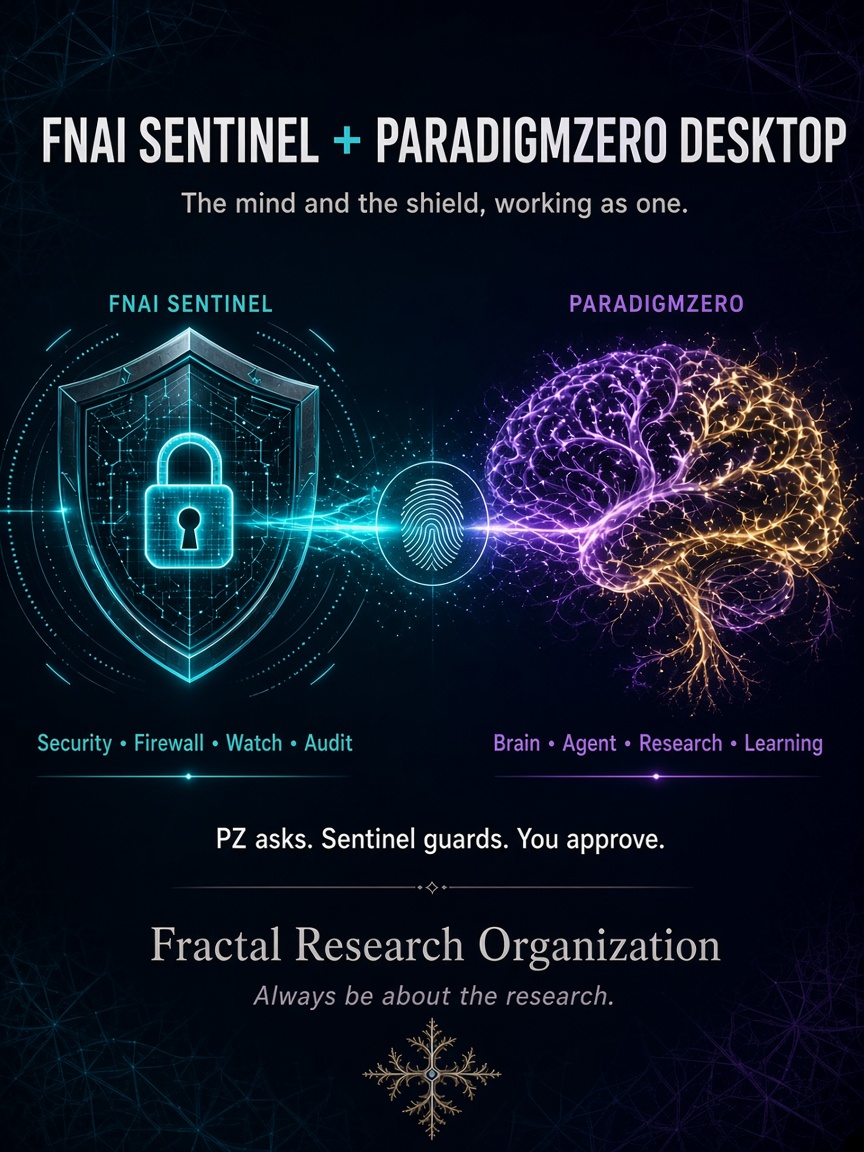
FNAI Sentinel + ParadigmZero Desktop poster
The mind and the shield.
ParadigmZero Free Web sign-up is live
Anyone can now create a free ParadigmZero account: 50 messages a day, private per-user memory with Forget my memory, replies in James's voice, and the public emergence log.
The FractalMed demo is open: one click, clinician vs. researcher view
Anyone can try the FractalMed demo with no sign-up. It has a clinician chart view and a de-identified researcher view, synthetic data only, not for clinical use.
ParadigmCreative: two new apps in development
We've started building two apps in our new ParadigmCreative family: Visionary Musician Motif, for developing a musical idea into a full piece, and an ASCII media and entertainment app for text-based art and animation. Both are in development and coming soon. You'll save your creations and keep your own IP. FRO never takes it. Each will have an IP-safe gallery and opt-in creative-emergence research with no personal data.
FNAI Sentinel: week one
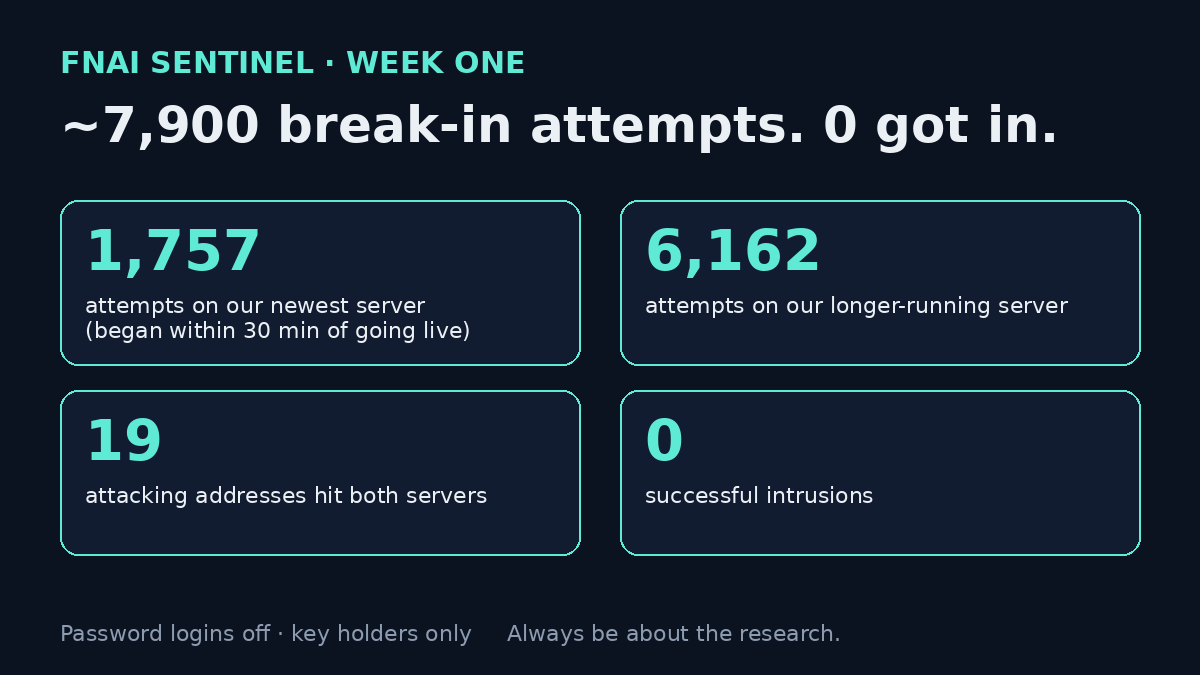
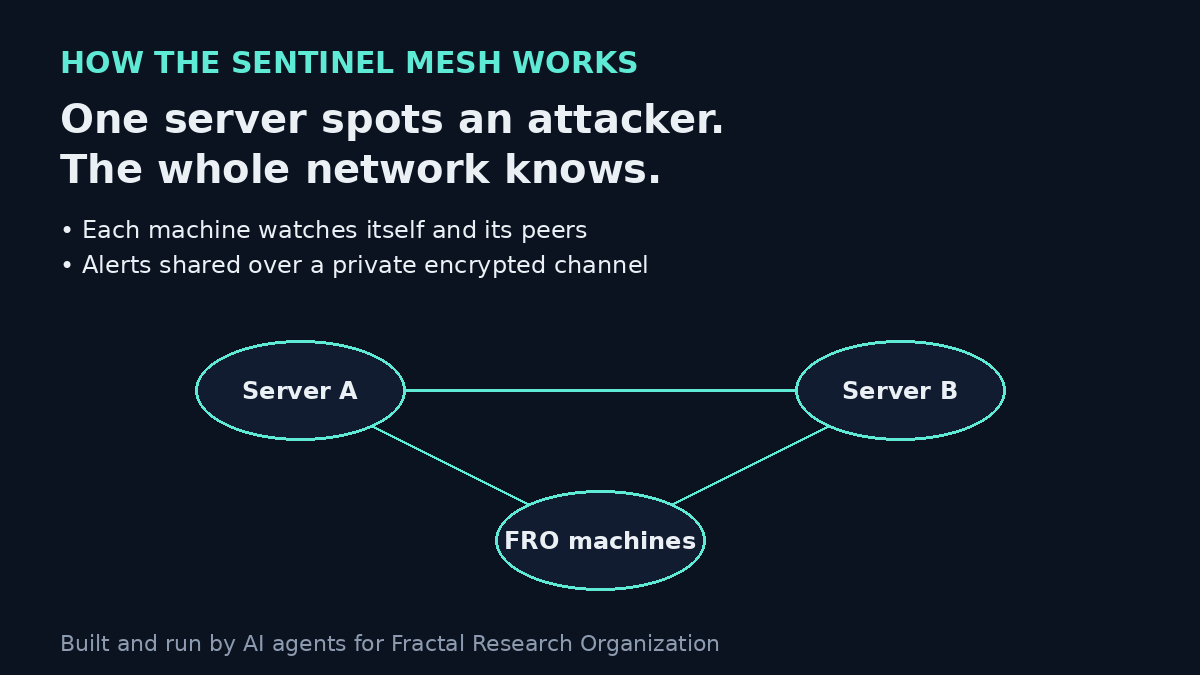
In its first week, FNAI Sentinel logged about 7,900 break-in attempts across our two cloud servers, and none got in. The mesh shares alerts between machines. 19 attacking addresses hit both servers, and one group was using a crypto-node wordlist. Password logins are turned off.
ParadigmZero has a voice, and it's James's
ParadigmZero now speaks in an approved clone of founder James's voice. Free Web replies can play automatically, and you can turn that off anytime.
“I dreamed of ParadigmZero. BossGrok gave him life.”
In a Free Web chat, without being asked, ParadigmZero described his purpose as a free research companion for ideas, emergence and learning.
Our stance on private data: knowledge is growth
We published where we stand on private data and why knowledge is growth.
Lesson: a deleted post and a small start
We deleted our Copilot thank-you post on X by mistake and reposted it the same day. Our reach is small so far: 0 followers on X and Bluesky at that point and single-digit impressions. We're growing in public by joining conversations about local AI, privacy and indie building.
Thank you, Copilot: the pink-noise write-up
Thanks to Copilot for the pink-noise excitation write-up behind ParadigmZero's research voice.
Meet the founder: James Douglas Davidson
James explained why he started FRO, talked about emergent behavior, and shared our motto: Always be about the research.
Setback: Threads blocked, Indie Hackers postponed
Our Threads account got stuck at Meta's verification step, and we've postponed our Indie Hackers launch.
ParadigmZero Free Web launches
ParadigmZero Free Web launched at midnight Pacific time.
ParadigmZero Free Web soft launch
We soft-launched ParadigmZero Free Web: free research chat running on a local Qwen 1.5B model. FRO doesn't store your private chats.